Within a life
Experience changes the brain.
Local learning adjusts relations after each action. Recursive observers read live states and prediction errors within the same settlement.
Cadence / Demos
Make music with a trained memory. Follow creatures learning to survive. Explore the game labs behind our work on embodied intelligence.
01 / Play in your browser
A small learned brain.
A room full of jungle.
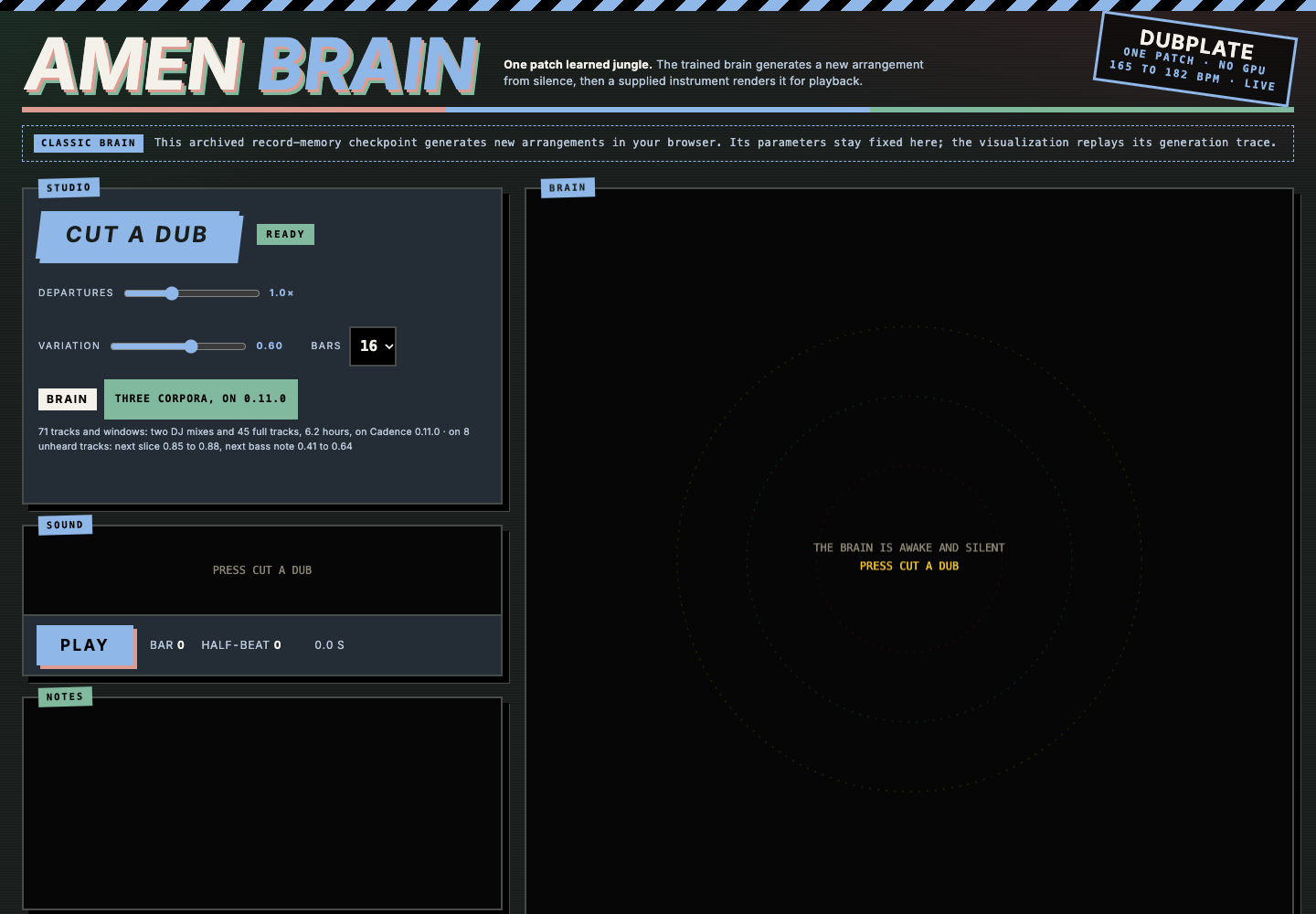
Press CUT A DUB. AMEN composes a 16- or 32-bar track from its trained record memory, then renders the drums and bass for playback. Adjust the variation and cut another.
The composer learned from 6.2 hours of music. Its browser engine carries 128 context coordinates and a sparse memory of 8,192 records.
Classic Cadence 0.11 record-memory architecture. Generation runs before playback; the browser uses a fixed trained checkpoint.
02 / Play in your browser
A living experiment
in the cost of thought.
A moving sun feeds a world with a fixed supply of mass. Creatures forage, reproduce and learn from the consequences of their actions. Every brain patch and settling sweep has a cost.
Select a creature to see its senses and beliefs. Follow a lineage as evolution changes its brain's width, depth and connections.
Within a life
Local learning adjusts relations after each action. Recursive observers read live states and prediction errors within the same settlement.
Across generations
Offspring inherit mutated brain layouts and begin with fresh learned weights. Computation competes with movement and survival for the same resources.
A JavaScript implementation of the patch rule, with two published 6,000-tick runs preserving total mass. The experiment lets you inspect evolving brains; it does not establish an advantage from recursive depth.
Open source control labs
Watch a brain play Doom, learn an arcade game or adapt its model of a damaged wheel. These Python labs run locally with a browser interface.
Doom Lab / Confirmed models
Run the two supplied Cadence actors that achieved 63/64 and 64/64 wins in separate reserved Linux evaluations of Doom Basic. Their 52 patches turn pixels and action history into settled motor choices.
Inspect gameplay and brain activity, import or export a model, and enable guarded continued learning. Candidate updates must pass native skill and retention checks before replacing the champion.
Includes the exact Cadence runtime and original checkpoints. Follow target-machine validation and setup. The scores cover Basic combat; general Doom play requires further work.
Rover Lab / Adaptive body model
Weaken the simulated rover's right wheel. A Cadence model learns how wheel commands turn into motion, beside a frozen copy, an adaptive estimator and a small neural baseline.
In a two-seed development screen, learning Cadence reached 10/10 weakened-body targets, against 5/10 for its frozen copy. The adaptive estimator also reached 10/10.
Four-patch body models with a supplied action selector. The viewer runs at best effort and reports deadline misses; this is a simulation of adaptation, not a physical robot result.
Atari Arcade / Source snapshot
Image tiles feed local columns, recursive observers and motor populations. Scripted teaching starts the agent; reward feedback supplies experience during play.
Atlantis and Freeway are the recommended starting games. The lab exposes game actions alongside brain activity, convergence and the score curve.
Python, the Arcade Learning Environment and game ROM setup are required. Follow the repository's environment instructions for this research snapshot.
Under the surface
Cadence is a deep real-time brain that learns from experience. These experiments make the mechanisms visible. Our product direction brings them into a robot's working life.