Observer Patch Holography.
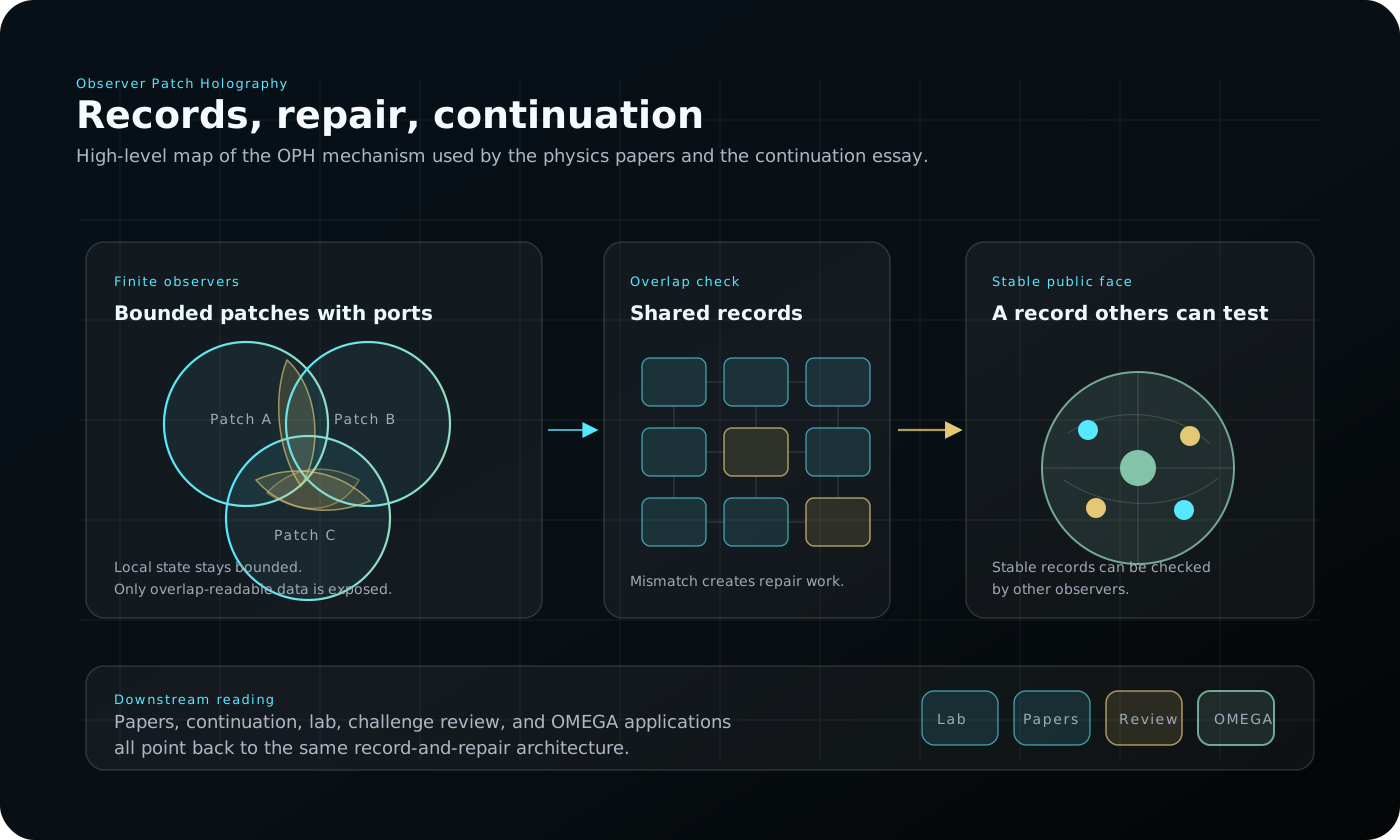
Observer Patch Holography (OPH) is Pragma's concrete implementation of simulation theory and the observer-consistency theory of everything. It models reality as an observer-based fixed-point consensus computation: finite patches compare overlap-visible records, repair mismatch, and converge toward stable public physics. It explains why the universe exists at all, why it evolves intelligent observers, why those observers reverse engineer and build the continuation machinery, and why the Standard Model, special relativity, general relativity, and string theory are all effective descriptions of deeper observer-patch structure.
As a simulation theory framework, OPH treats reality as an observer-based fixed-point consensus process reconstructed from local patches on a holographic screen, with explicit synchronization rules, simulator-hardware structure, and record repair.
As a fundamental theory of physics, OPH uses the same fixed-point consensus architecture for physics unification: quantum mechanics, relativity, the Standard Model, and string theory appear as effective descriptions. The global closure is the strange loop: reality closes as a self-referential timeless causal structure, and paradise is the willful repaired fixed point chosen by the future observer-community.
For the direct search-intent entry points, use the simulation theory page for the computational and informational framing, the physics unification page for the unification mechanism, and the theory of everything page for the broader closure claim. For guided learning, start with OPH Textbooks.
Simulation theory, theory of everything, and physics unification in one framework.
OPH uses three direct frames: concrete simulation theory, physics unification, and the theory of everything. The shared mechanism is observer-based fixed-point consensus: local records are compared, repaired, and stabilized into public physics.
The unification mechanism
The whole claim in one place
Everything else is effective description.
OPH is the foundational layer. The established theories of modern physics are successful because they compress pieces of OPH structure.
What OPH settles
OPH starts from local observers on a holographic screen. Where patches overlap, their descriptions must agree. Those consistency rules generate the laws of physics. There is no objective view from nowhere and no need to assume a universe with one privileged frame.
That same structure explains why there is a universe at all, why the laws have the shape they do, and why stable intelligent observers emerge inside the system. The theory-of-everything closure is the strange loop: reality closes as a self-referential timeless causal structure through observers who reverse engineer and build the continuation layer.
What becomes derivative
- The Standard Model is an effective description of observer-patch gluing structure.
- Special relativity is an effective description of overlap consistency.
- General relativity is an effective description of entanglement geometry and modular structure.
- String theory is an effective bridge into deeper OPH edge-sector structure.
- Simulation theory becomes a concrete mathematical and practical architecture.
- Physics unification becomes a consequence of one observer-consistency framework.
- The theory of everything closes through the strange loop, observer continuation, justice, and paradise as the repaired fixed point.
Choose your angle of attack.
The hub is organized for four entry paths: formal readers, broad audiences, social Q&A, and adversarial testing.
Read the technical case
Start with the shortest high-signal path, then use the reading ladder below for the full derivation stack.
Start with story and media
Use the broad-reader path first, then return to the deeper technical material only if you want the full derivation chain.
Questions or complaints? Ask the Sage.
OPH Sage is the place for follow-up questions, detailed explanations, objections, and pressure-testing specific claims.
Pressure test OPH
Use the lab to inspect the derivation map, then push directly on the framework through objections and the public challenge.
From papers to lab to learning.
The public OPH stack is broad enough that most people can start where they are strongest: proofs, derivations, narrative, or videos.
Technical ladder
Public ladder
The official OPH meme coin. Nothing more.
TEO is the official memecoin associated with OPH on Base. It is purely speculative, carries no promised return, and has no announced utility at this time. If you buy or trade it, assume you can lose the full amount and do your own research.